
VPN-Friendly Casinos in the UK: Access and Terms
 Available in GB
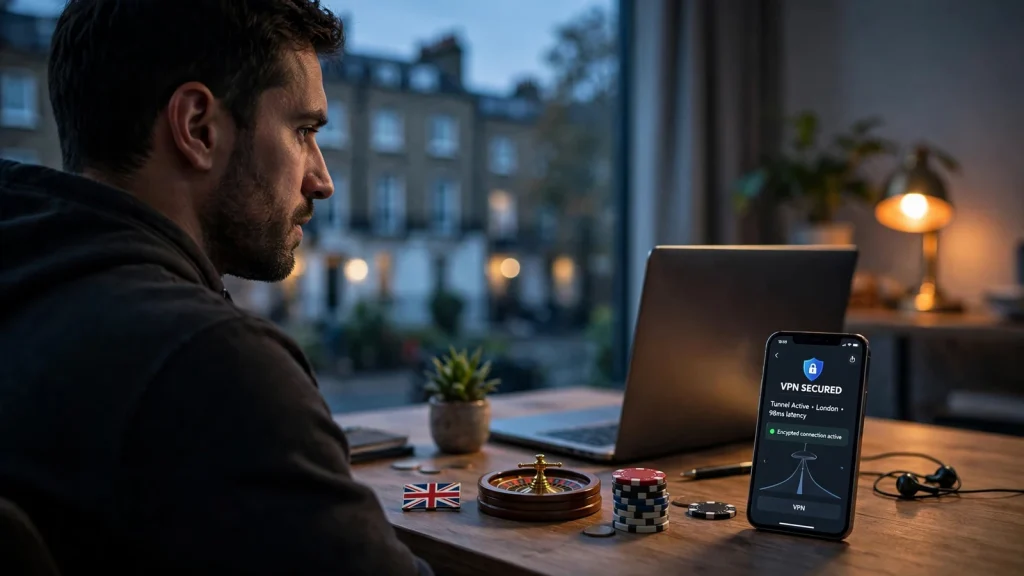
A VPN routes a connection through another server, but it does not guarantee account acceptance or remove casino checks.
Table of Contents
- What VPN-Friendly Casinos Are—and Where They Operate
- Assessing Offshore Offers Without a Ranked List
- VPN Casinos in 2026: Verification and Changing Terms
- Using a VPN at an Online Casino: Access Is Not Anonymity
- Crypto Payments and Withdrawal Timings
- Checking a VPN Casino Site’s Jurisdiction and Protections
- VPN Use and the UK Gambling Regulatory Framework
- Bitcoin Casinos: What the Available Evidence Establishes
- What a Casino VPN Connection Can—and Cannot—Do
- When a Casino Allows VPN Connections
- Casino Safety
What VPN-Friendly Casinos Are—and Where They Operate
A VPN-friendly casino is an online gambling site that permits a connection through a virtual private network. The label describes an access policy: it indicates that a casino allows a player to reach its website while using a VPN. It does not, by itself, describe the games offered, the quality of the site, or the conditions attached to an account.
The distinction matters because “VPN-friendly” can sound broader than it is. It does not mean that a casino has been built for VPN use, that every VPN connection will work, or that all players using a VPN receive the same treatment. It is a shorthand for permission to connect through this kind of network, not a general standard shared by every site using the label.
A VPN routes internet traffic through a server operated by the VPN provider. From the casino’s perspective, the connection therefore arrives through that network rather than directly from the player’s usual internet connection. Whether a gambling site accepts that connection is a separate matter from whether it accepts a particular player or account. The term “VPN-friendly” should consequently be read narrowly: it concerns the means of connecting, not a blanket assurance about access to every part of the service.
When considering a VPN-friendly casino in the UK, check the operator’s terms and local rules before connecting: VPN use may affect access or account verification. This reference card includes the payout-speed information available for each listed operator.
1. NightLuck
Payout speed: 1-3 business days NightLuck lists a payout speed of 1–3 business days.
2. Britsino
Payout speed: 1-3 business days Britsino lists a payout speed of 1–3 business days.
3. Jetsetspins
Payout speed: 1-3 business days Jetsetspins lists a payout speed of 1–3 business days.
4. Chanze
Payout speed: 1-3 business days Chanze lists a payout speed of 1–3 business days.
5. BeOnBet
Payout speed: 1-3 business days BeOnBet lists a payout speed of 1–3 business days.
6. Amunbet
Payout speed: 1-3 business days Amunbet lists a payout speed of 1–3 business days.
7. SlotoSport
Payout speed: 1-3 business days SlotoSport lists a payout speed of 1–3 business days.
8. EvoSpin
Payout speed: 1-3 business days EvoSpin lists a payout speed of 1–3 business days.
9. WinBeast
Payout speed: 1-3 business days WinBeast lists a payout speed of 1–3 business days.
10. Revery Play
Payout speed: 1-3 business days Revery Play lists a payout speed of 1–3 business days.
The offshore setting
VPN-friendly casinos are found mostly among offshore operators. Such sites are commonly associated with licences issued in Curaçao, the Isle of Man and Malta. These locations help describe the broad market in which the term is used, but they do not make the sites identical. The label does not indicate a single operator, a shared set of rules or a uniform approach to players connecting through a VPN.
“Offshore” here describes the operator’s licensing context rather than the location of the player. A site can be available online to someone in the United Kingdom while being operated under a licence issued elsewhere. The VPN-friendly label is often used in descriptions of this offshore segment because these operators are more commonly associated with allowing VPN connections than UK-facing sites are.
The phrase should not be mistaken for a formal category of gambling licence. It is a descriptive term used to distinguish sites that allow VPN connections from those that do not. A licence and a connection policy answer different questions: the licence identifies a regulatory framework for an operator, while the VPN-friendly description concerns whether a connection through a virtual private network is accepted. Neither term alone provides a full account of how a particular casino operates.
The range of jurisdictions also cautions against treating “offshore casino” as a precise description of one business model. Operators licensed in Curaçao, the Isle of Man or Malta may differ in their services and policies. The shared feature relevant to this label is not a common portfolio or identical set of conditions; it is the reported willingness to accept VPN connections.
Anjouan Casino Licence in the UK: What It Means
What the label does not establish
The wording offers limited information. It does not prove that a casino will accept every VPN service, every connection route or every account. Nor does it establish that the casino allows all activities from every location. Those questions depend on the operator’s own conditions, which are distinct from the general meaning of the label.
Searches for online casinos that allow VPNs can therefore point towards a type of site, but the phrase alone cannot identify whether a particular operator fits the description. A casino may be presented as VPN-friendly in general terms, yet the label does not explain the scope of that permission. It is best understood as a starting description of connection access, not as evidence of a broader promise.
Similarly, “VPN casino” is informal shorthand rather than a separate kind of gambling product. The casino remains an online gambling site; the VPN concerns the route used to connect to it. This distinction prevents the terminology from implying that a VPN changes the underlying nature of the service or the operator’s licensing arrangements.
The category is therefore useful mainly as a broad map of the market. It points towards offshore operators, many of them licensed in Curaçao, the Isle of Man or Malta, that allow connections made through a virtual private network. Beyond that core meaning, the label should not be asked to carry conclusions about the operator, its terms or the experience of using its site.
Trusted UK Casino Guide: Licensing and Checks
Assessing Offshore Offers Without a Ranked List
A welcome bonus is not a measure of value on its own. Its stated amount can attract attention, but the conditions attached to it determine what must happen before bonus funds, or winnings associated with them, can be withdrawn. For offshore offers, the wagering requirement is a central part of that assessment. A bonus should not be treated as meaningful until the requirement and the rules for meeting it have been read together.
A specialist review reports wagering requirements of 30x, 40x or 50x on offshore welcome bonuses. Other reporting puts the possible upper end at 60x, so the published figures do not align. These figures should therefore be read as reported examples, not as a uniform market standard or as a prediction of the terms on any particular site. The actual offer rules are the relevant evidence for an individual promotion.
The multiplier also needs context. The terms should make clear which balance it applies to and what activity counts towards completing it. A requirement applied to the bonus alone is not equivalent to one calculated against the deposit and bonus combined. Where that distinction is unclear, the headline figure cannot be used to estimate the workload reliably. A reader comparing promotions needs the full calculation, not merely the multiplier displayed beside the offer.
What to establish before comparing offers
The practical starting point is the complete set of promotion terms, rather than a summary card or headline. It should identify the qualifying deposit, the bonus amount, the wagering calculation and any conditions that affect withdrawal. A summary may omit qualifications that appear in the detailed terms; if the two appear inconsistent, the offer cannot be assessed confidently from the summary alone.
USA Casinos for UK Players: What the Label Means
Game eligibility is another material issue. Terms may specify which games contribute towards wagering, or whether different games count differently. If the offer does not explain how eligible play is treated, it is difficult to know how much of the stated requirement can be completed through the games a player intends to use. The presence of a bonus does not establish that all casino games contribute equally.
The permitted stake while wagering is also worth checking. A promotion may impose a maximum bet or other play conditions while the requirement remains active. Such restrictions can affect whether a player’s normal pattern of play is compatible with the offer. The assessment should be based on the written conditions, not on assumptions drawn from the size of the advertised bonus.
Expiry rules and withdrawal provisions matter for the same reason. The terms should state whether there is a deadline for completing the requirement and what happens if it is not met in time. They should also explain whether a cash-out cap, bonus cancellation rule or other restriction applies. Without those details, a large headline offer may have limited practical value. These are questions to resolve from the promotion’s actual wording, rather than features that can be inferred from an offer’s appearance.
Comparing unlike promotions
A comparison is meaningful only when the same elements are examined for each offer. That means considering the calculation base, eligible games, any stake restrictions, the time allowed and the consequences of withdrawing or failing to complete the wagering. Comparing only the bonus amounts can produce a misleading order: a smaller offer with clearer or less demanding conditions may be more intelligible than a larger offer whose restrictions are extensive or poorly explained.
Assessing Offshore Bonuses
- Read the complete set of promotion terms
- Identify the qualifying deposit and bonus amount
- Verify the wagering calculation and eligible games
- Check for maximum bet restrictions during wagering
- Confirm the expiry deadline and withdrawal provisions
The wording itself is evidence. Terms that define key conditions plainly allow the offer to be evaluated; ambiguous language leaves important outcomes uncertain. This does not establish that an unclear promotion will be applied in a particular way. It means the value cannot be determined with confidence from the information presented. Claims that a bonus is “easy” to clear are not a substitute for a stated calculation and complete rules.
A ranked list would conceal these differences by implying that a single measure can capture the value of every promotion. It cannot. The same wagering multiplier may have a different practical effect depending on what it applies to, which games qualify and what restrictions apply during play. Conversely, a low-sounding multiplier is not sufficient evidence of a favourable offer if other conditions limit its use or affect withdrawals.
Treating the offer as a contract, not a headline
Before accepting a promotion, the relevant question is not simply how much bonus credit is advertised, but what obligations and limits accompany it. If the calculation base, eligible play, deadline or withdrawal conditions cannot be identified, the offer remains difficult to assess. The uncertainty should not be filled by assuming that the most favourable interpretation will apply.
A careful comparison therefore separates the promotional claim from the enforceable terms. The reported wagering figures provide context, but they do not identify the conditions of a particular casino offer. Only the current promotion rules can establish those conditions, and they should be read in full before a bonus is treated as having a definite value.
VPN Casinos in 2026: Verification and Changing Terms
A casino accepting a connection made through a virtual private network does not thereby promise anonymous play. Connection access and identity verification are separate matters. A site may permit a VPN connection while retaining the right to request documents as part of its checks, including when a withdrawal is being reviewed.
That distinction is important when assessing claims about a VPN casino. “VPN-friendly” describes an approach to connections; it does not establish that a casino waives Know Your Customer (KYC) checks, or that a player can withdraw without being identified. Any assumption that access through a VPN removes verification requirements goes beyond what the term itself means.
Some offshore casinos are reported to allow small withdrawals without documents, then require KYC once a higher withdrawal threshold is reached. The threshold is often stated as £1,000 or its equivalent in cryptocurrency. This is a description of a practice reported for some casinos, not a standard that applies across the sector. It does not establish that a particular site will defer checks until a withdrawal, or that it will use that threshold.
The timing of a request can therefore matter. A player may have been able to register, deposit or make a small withdrawal without being asked for documents, yet face a request later when seeking a larger payment. An earlier transaction without a document request should not be treated as evidence that no further checks will occur. Nor does a VPN-friendly label settle what the operator may ask for during account or withdrawal review.
The practical terms are those set by the individual casino. They may distinguish between verification at account opening and checks triggered later, but those details need to be read in the operator’s own terms and withdrawal conditions. If the wording is unclear about when KYC can be required, the uncertainty remains: a general description of the site as VPN-friendly cannot fill in the missing detail.
KYC Thresholds
Some offshore casinos are reported to allow small withdrawals without documents, often requiring identity verification only once a threshold of £1,000 or its cryptocurrency equivalent is reached.
Policies can also change. Offshore casinos may alter their VPN rules without notice, so a connection that was accepted at one point does not prove that the same access will remain available. A policy change may affect an account even if the player has previously used the site without a problem. The terms in force at the relevant time, rather than an old description or past experience, determine the operator’s stated position.
A VPN can also create a mismatch between the connection and information supplied during verification. Where the casino’s terms prohibit UK players, using a VPN to conceal location can lead to account closure and the confiscation of winnings; a breach may also result in account termination after a win. These are material risks, not technical inconveniences. A casino allowing a VPN connection does not amount to permission to misrepresent eligibility or to a guarantee that funds will be released.
Age checks are another distinct part of verification. Operators must verify a customer’s age before allowing deposits into a gambling account. That requirement is not displaced by a VPN connection or by a casino’s willingness to accept traffic routed through one. More broadly, the absence of an early document request should not be confused with an exemption from checks.
For a VPN casino in the UK market, the useful distinction is therefore between access conditions and verification conditions. Access concerns whether the connection is accepted. Verification concerns what information the operator may require, and at what point it may ask for it. These can be governed by different clauses and may change independently. A site’s marketing label alone cannot establish either the precise KYC process or the continued availability of withdrawals under changing terms.
Using a VPN at an Online Casino: Access Is Not Anonymity
A VPN can change the IP address that an online casino sees, making a connection appear to come through a network outside the UK. That may affect whether a site allows the connection, but it does not establish where a player is located for every purpose, remove identity checks or grant permission to gamble.
For UKGC-licensed operators, location verification is a legal requirement. A VPN may therefore prompt a block rather than provide access: the changed IP address can conflict with the operator’s checks. Passing an initial connection screen would not show that those checks have been satisfied or that the operator will accept continued play.
Location checks and know-your-customer verification are distinct processes. KYC concerns a player’s identity and can involve requests for documents; changing an IP address does not replace that process. A connection that appears to originate elsewhere is not proof of identity, eligibility or permission to use a gambling service.
Why a VPN does not make play permissible
Whether a VPN connection can be established is a technical matter. Whether play is allowed is a separate question governed by the operator’s obligations and conditions. Using a VPN does not make gambling at a UKGC-licensed casino safe or permitted where the operator’s rules or location checks do not allow it. Nor does an apparent change of location cancel the operator’s duty to verify location.
Account Risk
Using a VPN to conceal your location where a site’s terms prohibit UK players can lead to account closure and the confiscation of winnings.
The distinction matters because access can be temporary. A site may initially load while further checks remain incomplete. If information later conflicts with the connection, the account may be reviewed. Where a site’s terms prohibit UK players, concealing location can lead to account closure and the confiscation of winnings; a win does not remove that risk.
Keeping a VPN connection stable throughout a session may avoid abrupt changes in the apparent connection, but consistency is not evidence that the casino has accepted the VPN or that play complies with its rules. It cannot turn a prohibited connection into an authorised one. A VPN should not be treated as a way to evade location checks.
The practical answer to whether a VPN can be used for online casino access is therefore qualified: it may alter the connection route, but it cannot guarantee access, anonymity or permission to play. The same applies to questions about using a VPN to play at an online casino: the connection itself and the operator’s acceptance of the player are separate matters.
A VPN can serve other purposes, such as encrypting an internet connection, but that protection does not make a gambling account anonymous. Casinos may still carry out identity and location checks independently of the apparent IP address. The available distinction is straightforward: a VPN changes a network signal, while verification remains a separate process.
Crypto Payments and Withdrawal Timings
Crypto payments can change how a deposit is handled, but they do not make a casino transaction anonymous. For small deposits, paying in cryptocurrency may reduce the location checks and identity-verification friction associated with some other payment routes. That is a limited difference in processing, not an absence of oversight: casinos still collect device fingerprints, IP logs and browser data.
The distinction matters because a payment method and a connection method address different parts of a transaction. A VPN changes the apparent network location, while a crypto deposit changes how funds are transferred. Neither step removes the information a casino can gather from the device or browser, and reduced checks on a small deposit do not establish that the same account will face no checks later. Payment convenience should therefore not be read as proof that identity or location requirements have been waived.
Withdrawal timing also depends on the payment route. A specialist review of VPN-friendly casinos describes fiat withdrawals through an e-wallet or bank transfer as taking between one and five days. That is a reported range from a review, not a dependable timetable for every operator or transaction. An e-wallet withdrawal is separately described as taking about a day. These descriptions are not necessarily inconsistent: the broader range includes different fiat methods, while the shorter estimate concerns e-wallets specifically. Neither establishes how quickly a particular account will be paid.
Crypto withdrawals are described in a specialist review as being processed within minutes to a few hours. This should likewise be treated as a source-specific account of processing, rather than a universal service standard. The reported interval does not establish that every request will be completed within it, or that a casino’s internal review and the onward movement of funds are the same step.
There is also a practical distinction between a casino initiating a withdrawal and the funds becoming usable in the destination account or wallet. A stated processing interval may describe only the operator’s handling of a request; the payment route has its own mechanics. A short crypto processing estimate should not be treated as a guaranteed end-to-end delivery time.
Fiat Withdrawals
Reported as taking between one and five days through e-wallets or bank transfers.
E-wallet Withdrawals
Separately described as taking approximately one day.
Crypto Withdrawals
Reported as being processed within minutes to a few hours.
For a small deposit, crypto may reduce friction at the point of payment, but the effect is narrow. Device, IP and browser data remain available to the casino, and payment processing does not itself settle questions about account checks. Similarly, a published withdrawal estimate says little about the treatment of a particular account or the requirements attached to it. The method used to move funds is only one part of the transaction.
The clearest comparison is therefore between reported processing descriptions, not guaranteed outcomes: a specialist review gives a broader interval for fiat withdrawals, a separate approximate estimate for e-wallets, and a shorter reported window for crypto withdrawals. These figures describe what those sources report about particular services; they should not be presented as fixed market-wide performance.
Checking a VPN Casino Site’s Jurisdiction and Protections
A VPN-friendly casino site’s location and licensing status are not interchangeable details. A site may accept connections routed through a VPN while operating outside the UK Gambling Commission’s framework. The connection method does not change the operator’s jurisdiction or provide the protections attached to a UKGC-licensed account.
The distinction matters because offshore casinos are not regulated by the UKGC and have no obligation to follow UK laws. A licence issued elsewhere does not amount to a UKGC licence. Where a site identifies a regulator or licensing jurisdiction, that information describes the framework under which it operates; it does not establish that the site is authorised to serve customers in Great Britain under UK rules.
What jurisdiction details establish
A site’s terms and licensing information can help identify the legal entity behind the service and the jurisdiction it claims to operate under. That is relevant when assessing what regulatory system applies to the casino. A reference to an offshore licence should not be read as evidence of UKGC oversight, even if the site accepts UK connections or permits VPN use.
The distinction is particularly important for VPN casino sites because access can create a misleading impression of availability as approval. A functioning account or successful connection says little about the protections available if a dispute arises. Nor does a casino’s own description of its licence make it part of the UK regulatory system.
Playing at an offshore casino that permits VPN connections means forfeiting UK consumer protections. This is a material consequence of choosing a site outside the UKGC framework, not a technical consequence of the VPN itself. The VPN changes how a connection is routed; it does not transfer the operator into a different regulatory system or restore protections that do not apply to the offshore service.
Casino Safety: Licensing and UK Casino Sites
Limits of safer-gambling support
Self-exclusion is another area where jurisdiction has practical importance. Offshore casinos do not provide GamStop self-exclusion tools. As a result, a person who relies on GamStop cannot assume that an offshore account will be covered by that scheme. The use of a VPN does not alter this limitation.
The absence of GamStop should not be confused with a claim that every offshore operator has no account controls of any kind. The relevant point is narrower: GamStop is not provided by offshore casinos, so its protections cannot be assumed to extend to them. This difference is worth considering alongside licensing status, rather than treating VPN acceptance as a sign that the site offers equivalent safeguards.
Assessing the information presented
Jurisdiction and licensing statements should be read together with the operator’s terms, rather than treated as decorative labels. The key distinction is whether the site is within the UKGC system or operates offshore. A foreign licence may identify a regulator, but it does not give the site UKGC status, and accepting users who connect from Britain does not itself confer that status.
Non-UK Regulated Casinos: UK Rules Explained
For VPN-friendly casino sites associated with the UK, the central assessment is therefore not simply whether the connection works. It is whether the operator sits within the protections of the UKGC framework, and what safeguards are unavailable when it does not. Where a site is offshore, the consequences include loss of UK consumer protections and the absence of GamStop. These limits remain relevant regardless of the apparent ease of access through a VPN.
VPN Use and the UK Gambling Regulatory Framework
The UK Gambling Commission oversees commercial gambling in Great Britain and is the sole regulator for that activity there. Its remit includes remote gambling offered to consumers in Great Britain; the location of an operator’s key equipment does not, by itself, place that service outside the Commission’s regulatory scope.
The Commission issues operating licences to gambling businesses and personal licences to individuals working in relevant roles. A remote operator offering gambling to Great Britain consumers must hold the appropriate operating licence. This licensing framework concerns the operator and the service being offered, rather than the technology a player uses to connect.
The distinction matters when considering whether a VPN is allowed at an online casino. UK law does not criminalise VPN use for gambling, but that does not make every online casino legally available to people in Britain. Online gambling is legal in the UK only when offered through a properly licensed and regulated site. A VPN connection does not give an offshore operator a UKGC licence or alter the regulatory status of its service.
Nor does the Commission’s licensing role amount to blanket permission to use a VPN at a UKGC-licensed casino. Whether a particular operator accepts VPN connections is a separate matter from the regulator’s remit. The framework establishes which businesses may lawfully offer remote gambling to consumers in Great Britain; it does not make VPN use a substitute for an operator’s licence or determine every connection policy.
Accordingly, the answer to whether VPNs are allowed at UK casinos depends in part on what “allowed” means. VPN use itself is not criminalised, while the legality of the gambling service depends on the operator’s regulatory position. These are distinct questions: the first concerns use of a connection tool, and the second concerns whether the casino is authorised to serve the market. A VPN does not change the licensing requirement that applies to remote operators serving Great Britain.
Bitcoin Casinos: What the Available Evidence Establishes
Bitcoin is a cryptocurrency, but a general reference to crypto payments does not establish that a particular VPN-friendly casino accepts Bitcoin. Nor does it show whether Bitcoin can be used for both deposits and withdrawals, or whether the same conditions apply in each direction. Those details are specific to an operator’s payment terms and cannot be inferred from a broad description of crypto support.
Non-UK-Registered Casinos: Regulation and Risks
The distinction matters because crypto is a category, not a single payment method. Statements about crypto transactions may cover different assets and do not, by themselves, describe Bitcoin processing. A casino’s use of a crypto label is therefore not enough to establish Bitcoin availability or the terms attached to it.
A specialist review of VPN-friendly casinos has reported crypto withdrawals being completed in a period ranging from minutes to a few hours. That is a source-specific account of crypto processing, not a general service standard, and it does not establish the timing for Bitcoin withdrawals at any individual site. Processing can only be assessed against the relevant operator’s stated conditions; the broad estimate should not be treated as a promise.
Searches for VPN-friendly Bitcoin casinos may combine two separate questions: whether a casino permits connections through a VPN and whether it accepts Bitcoin. Evidence for one does not answer the other. Neither description, on its own, establishes that a site’s policies will remain unchanged or that a particular transaction will be handled on the same terms as other crypto payments.
The careful distinction is between crypto-related information and Bitcoin-specific claims. General statements about crypto processing can provide context, but they should not be converted into assurances about Bitcoin support, withdrawal timing or transaction conditions at a particular casino. A Bitcoin label alone cannot settle those questions.
What a Casino VPN Connection Can—and Cannot—Do
A VPN changes the IP address visible to an online casino by routing the connection through another network. It also encrypts the internet connection, which can help protect personal information from hackers and other cybercriminals while data is being transmitted. These functions affect the connection; they do not make a casino session anonymous.
A casino may still gather information through other channels, including device fingerprints, browser data and records of IP addresses used to connect. A changed IP therefore does not erase the wider digital record associated with an account or device. Nor does encryption prevent the casino itself from collecting information through its website or account systems.
Payment method does not remove those limits. Crypto deposits may reduce location checks and identity-verification friction for small amounts, but casinos can still collect device, browser and connection data. A VPN should not be treated as a substitute for verification or as a way to prevent a casino from associating activity with an account.
Where a casino permits VPN connections, the connection should remain active throughout the session; changing network routes mid-session may trigger automated checks. That does not guarantee uninterrupted access or anonymity. The practical distinction is between protecting data in transit and concealing activity from the casino: a VPN can encrypt the former, but it cannot reliably achieve the latter.
When a Casino Allows VPN Connections
A casino accepting a connection routed through a VPN is not necessarily agreeing to serve customers in the UK. Connection access and eligibility under the site’s terms are separate matters. Most UKGC-licensed operators block VPN connections, while an offshore operator may allow one but still exclude UK residents in its conditions.
Those conditions determine what the operator says it may do if it identifies a location or account detail that conflicts with its rules. If UK players are prohibited, access through a VPN does not remove that restriction. The account may be closed, and a breach discovered after a win may put the balance at risk, including possible confiscation of winnings. VPN policies can also change without notice, so permission at one point does not establish continuing permission.
An offshore casino operates outside the UKGC framework and has no obligation to follow UK gambling laws. A UK resident is not criminally liable simply for playing at an offshore casino, but that does not provide the protections attached to a UKGC-licensed operator. The distinction is therefore between the player’s legal position and the contractual consequences imposed by the site.
A VPN-friendly label describes a connection policy, not a guarantee that UK customers are eligible, that an account will remain open, or that winnings will be paid. The decisive issue is whether the casino’s own terms permit play from the UK and use of a VPN; where those terms exclude either, technical access should not be mistaken for authorisation.
Can I use a VPN to play at online casinos in the UK?
Yes, if the casino accepts VPN connections; VPN-friendly sites are mostly offshore, while most UKGC-licensed operators block VPN connections. Using a VPN to gamble is not criminalised by UK law, but playing at an offshore casino means giving up UK consumer protections.
Why do UK players use VPNs for casinos?
A VPN can mask a player’s IP address and help bypass access restrictions imposed by UK internet service providers. It also encrypts the internet connection, helping protect personal information from hackers or cybercriminals.
How do I withdraw winnings from a VPN casino?
Offshore casinos may offer fiat withdrawals by e-wallet or bank transfer, which take 1–5 days; e-wallet withdrawals take about a day, while crypto withdrawals can take minutes to a few hours. Some casinos require KYC documents after a larger withdrawal threshold, often £1,000 or its crypto equivalent.
Are VPN-friendly casinos legal for UK players?
It is not illegal for a UK resident to play at an offshore casino, and using a VPN to gamble is not criminalised by UK law. However, playing at an offshore casino means forfeiting UK consumer protections, and these casinos do not provide GamStop self-exclusion tools.
Is it illegal to use a VPN to gamble in the UK?
No. Using a VPN to gamble online is not criminalised by UK law, although UKGC-licensed operators generally block VPN connections.
Casino Safety

Anjouan Casino Licence in the UK: What It Means
Anjouan authorisation does not replace a UK Gambling Commission licence for gambling services supplied in...

Foreign Casinos for UK Players: How They Work
A practical explanation of how non-UKGC sites operate, what offshore licensing means, and where British...

International Casinos for UK Players: Licensing Guide
The guide explains how UK licensing affects access and protection, and what to weigh across...

Offshore Casino Sites in the UK: Licensing Explained
The guide distinguishes operators outside UKGC licensing from overseas-based firms that hold a UK licence,...

Offshore casinos for UK players: how to assess sites
In the UK market, offshore means accepting British customers without a UKGC licence—not simply operating...

British Casinos Not on GamStop: Rules and Risks
The guide distinguishes UKGC-regulated sites from casinos outside GamStop and examines licensing, bonus terms, safeguards...

Casino sites not registered with GamStop in the UK
GamStop participation follows UKGC licensing, while a casino’s branding or game range does not establish...

Non-UK Licence Casinos: Regulation and UK Rules
Licensing depends on the regulator and the markets an operator is authorised to serve, not...

Casino Without a UK Licence: Regulation and Risks
A foreign gambling licence does not provide UKGC oversight or establish the protections available to...

Casinos That Bypass GamStop: Risks and Limits
GamStop’s reach, offshore licensing and reported workarounds raise distinct questions about protection, access and risk....

Curaçao Casino Licence UK: What It Means
A Curaçao licence identifies an offshore licensing framework, but does not by itself show that...

Gibraltar Casino Licence and UK Gambling Rules
A Gibraltar licence concerns an operator’s status there; serving customers in Great Britain requires separate...

Merkur Casino Online UK: Games, Demos and Checks
Merkur may name a game provider, a casino brand or a venue, so operator identity...

Most Trustworthy Online Casinos in the UK: Key Checks
A practical framework for weighing UKGC oversight, operator records, GAMSTOP claims and real-money terms without...

Non-Gamban Casinos in the UK: Self-Exclusion Explained
GAMSTOP coverage, direct site exclusions and the limits of labels clarify how UK online self-exclusion...

Non-GamStop Curaçao Casino Sites: UK Context
A Curaçao licence claim does not establish UK authorisation or whether a casino is covered...

Non-GamStop European Casinos and UK Self-Exclusion
GAMSTOP covers participating licensed online operators, while a request to one casino applies to that...

Non-UK-Registered Casinos: Regulation and Risks
The guide explains how UK law, GamStop access, payment conditions and licensing differ across casinos...

Non-UK Regulated Casinos: UK Rules Explained
A casino may hold a licence abroad, but that does not make it UK-regulated or...

Non-UKGC Licensed Casinos: Regulation and Risks
Non-UKGC describes a casino’s relationship with the British regulator, not whether it holds a licence...

Malta MGA Licence for Online Casinos: UK Rules
An MGA licence indicates status within Malta’s framework, but does not establish permission to offer...

Online slots not on GamStop: what the label means
The term describes a casino’s connection to GamStop, not a distinct slot format or game...

Safe Online Casinos in the UK: What to Check
A practical guide to UK licensing, account and payment checks, safer-gambling controls, and the limits...

Trusted Casinos Not on GamStop UK: What to Check
A closer look at licensing disclosures, player safeguards and site checks—and what they cannot establish...

Trusted UK Casino Guide: Licensing and Checks
UK licensing depends on offering remote gambling to Great Britain, while verification, withdrawals, bonuses and...

USA Casinos for UK Players: What the Label Means
The label alone does not show where an operator is based, who licenses it or...

































































































































































































































































