
Progressive Jackpot Slots: How They Work
 Available in GB
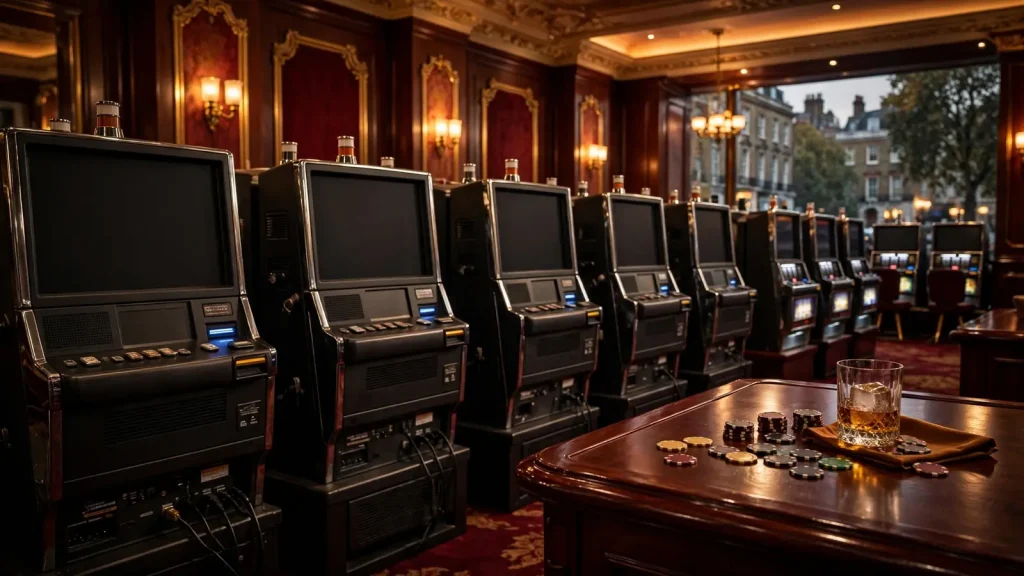
Progressive prizes grow through wagers on connected machines, while the pool and contribution mechanism depend on the particular game arrangement.
Table of Contents
- How Progressive Jackpots Build Across Connected Slots
- Progressive Jackpots Across Casino Networks
- Playing Progressive Slots Online
- How Progressive Jackpot Games Award the Prize
- Bet Conditions on Progressive Slot Machines
- Progressive Slots in the UK: Regulation and Access
- Free Spins, Bonuses and Progressive Jackpot Play
- Finding Progressive Jackpot Slots on Casino Sites
- RTP and the Cost of Progressive Jackpot Funding
- Withdrawing a Progressive Jackpot Win
- Casino Games
How Progressive Jackpots Build Across Connected Slots
A progressive jackpot is funded as play takes place across a group of connected slot machines. Wagers made on those machines contribute to a shared pool, rather than funding a prize confined to one individual machine. The pool therefore grows through contributions from multiple plays within the connected group.
This shared structure distinguishes progressive jackpot slots from games with a fixed top prize. In a fixed-prize game, the stated amount does not increase through contributions from other connected machines. With a progressive slot jackpot, contributions accumulate in the pool as wagers are placed. The value is linked to activity across the connected machines, although the precise contribution mechanism can differ between games.
The word “connected” matters: the shared pool relates to the machines participating in that particular arrangement. A progressive jackpot is not automatically pooled across every slot in a casino, or across every game with a progressive feature. The connection defines which wagers contribute to the same prize pool. A machine outside that group does not contribute to that pool merely because it is also a slot.
Progressive jackpot play can make payout arrangements an important part of choosing where to play. This reference highlights the payout-speed information available for each operator.
1. NightLuck
Payout speed: 1-3 business days NightLuck lists a payout speed of 1–3 business days.
2. Britsino
Payout speed: 1-3 business days Britsino lists a payout speed of 1–3 business days.
3. Jetsetspins
Payout speed: 1-3 business days Jetsetspins lists a payout speed of 1–3 business days.
4. Chanze
Payout speed: 1-3 business days Chanze lists a payout speed of 1–3 business days.
5. BeOnBet
Payout speed: 1-3 business days BeOnBet lists a payout speed of 1–3 business days.
6. Amunbet
Payout speed: 1-3 business days Amunbet lists a payout speed of 1–3 business days.
7. SlotoSport
Payout speed: 1-3 business days SlotoSport lists a payout speed of 1–3 business days.
8. EvoSpin
Payout speed: 1-3 business days EvoSpin lists a payout speed of 1–3 business days.
9. WinBeast
Payout speed: 1-3 business days WinBeast lists a payout speed of 1–3 business days.
10. Revery Play
Payout speed: 1-3 business days Revery Play lists a payout speed of 1–3 business days.
This explains why a progressive jackpot can be associated with several machines rather than one cabinet alone. Each participating machine provides a route into the same accumulating prize, while wagers across the group add to the pool. The jackpot is thus a collective feature of connected play, not simply a larger version of an individual machine’s ordinary payout.
The term “progressive” describes this accumulation: the pool changes as qualifying wagers are made on connected machines. It does not, by itself, specify how much of a wager is contributed or how the prize is eventually awarded. Those details depend on the game’s rules. The basic funding principle remains that connected slot machines contribute through wagers to a common jackpot pool, allowing the prize to build across the participating machines.
Progressive Jackpots Across Casino Networks
A progressive jackpot can extend beyond the individual casino site where a slot is played. When the same progressive slot is carried by multiple operators, its network jackpot pool is shared across those operators. The relevant connection is therefore between versions of the same game, rather than simply between casinos that offer slots or use similar branding.
This distinction matters because “network” describes the reach of a particular jackpot, not a general arrangement linking every casino. A progressive title at one operator may belong to a pool shared with other operators carrying that title. Another progressive game at the same casino may be associated with a different pool. The presence of several progressive jackpot casino slots on a site does not, by itself, mean that their prizes accumulate together.
3-Reel Slots in the UK: Finding Classic Games
The game title is central to understanding the relationship. If a progressive slot is available through multiple operators, the shared pool relates to that same title. A casino’s catalogue may include games from different providers, but provider identity alone does not establish that their jackpots are connected. Nor does the fact that two games are both progressive show that they feed the same prize. The established connection is title-specific: operators carrying the same progressive slot can share its network pool.
This also clarifies what “shared” means in this context. It refers to a common jackpot pool across operators carrying the game, not to a casino transferring its own prize to another casino. The pool is associated with the progressive slot across its participating operator network. A player encountering the title at one operator is therefore seeing a game whose jackpot is not necessarily confined to that operator’s customers.
The network perspective separates the location of play from the scope of the prize pool. A slot may appear within the games catalogue of a particular casino, while its progressive jackpot is shared across operators offering the same game. The casino is the venue through which the game is accessed; it is not necessarily the sole boundary of the jackpot. This is why a progressive jackpot casino cannot be understood only by looking at the individual site on which a title appears.
The same point applies to an online casino progressive jackpot. The online setting identifies where the game is played, but it does not, on its own, define how widely its pool is shared. The network relationship depends on whether other operators carry the same progressive slot. A title available at multiple sites may have a pool extending across those operators, whereas the mere availability of different progressive games at several sites does not demonstrate a common network.
Attention: The term "progressive jackpot casinos UK" does not describe a unified system; each game’s pool has its own specific network scope.
There are limits to what can be concluded from this arrangement. The fact that a pool is shared across operators carrying the same game does not specify which operators participate in a particular network, how many carry the title, or the geographical reach of the pool. It also does not establish that every casino displaying a game with a matching or similar name is connected to the same jackpot. The network relationship should not be extended beyond the same progressive slot without further evidence.
For the same reason, the term “progressive jackpot casinos UK” can be misleading if treated as though it describes one unified system. UK casinos may offer progressive titles, but each title’s pool has its own network scope. The shared arrangement attaches to the game across participating operators; it does not mean that all UK casinos offering progressive slots contribute to one collective jackpot. Nor does the shared-pool fact alone establish that every operator carrying a title makes the same game available in the same way.
A useful way to interpret a progressive jackpot is thus to distinguish three things: the casino where the slot is accessed, the specific progressive game, and the operator network associated with that game’s pool. These are related, but they are not interchangeable. Confusing them can lead to the mistaken assumption that a jackpot belongs exclusively to one casino, or that all progressive titles across several casinos feed a single prize.
Five-Reel Slots in the UK: Layouts and Play
The network model makes progressive slots less site-specific than their presentation may suggest. A jackpot displayed within one casino’s games catalogue can be shared beyond that operator when the same progressive title is carried elsewhere. At the same time, the shared scope should be attributed only to that title and its network, rather than to progressive games generally. This is the key distinction behind a network progressive jackpot: the prize pool is shared across operators offering the same game, while the casino through which the game is accessed remains a separate part of the arrangement.
Playing Progressive Slots Online
Online play changes the setting, not the basic funding principle of a progressive jackpot slot. A portion of qualifying wagers is directed to the jackpot pool, while the remainder supports the game’s other returns. Across progressive jackpot slots, the contribution is typically between 1% and 3% of each wager. The exact rate is associated with the game rather than being a universal figure for every title.
This means that the jackpot is not simply a prize attached to a fixed-stake game. Each wager contributes to a pool that can grow as play continues. The contribution is only one part of the stake, so it should not be confused with the amount wagered or with the full value returned through the slot’s ordinary play. A larger stake can produce a larger contribution if the game applies the same proportion, although the contribution rate itself is not necessarily identical across different games.
Contribution rates for progressive jackpot slots typically range between 1% and 3% of each wager, though this varies by title.
In an online slot, the funding process takes place within the game’s wagering system. The player sees a stake and a jackpot display, but those figures describe different things: the stake is the amount placed on a game cycle, whereas the displayed jackpot represents the accumulating prize pool. The relationship between them is indirect. A small fraction of each wager is allocated to the progressive prize, and the balance is not automatically added to that pool.
The contribution rate matters when comparing online progressive jackpot slots because the headline prize does not describe the full economics of a game. Two titles may both show a growing jackpot while directing different proportions of wagers towards it. The visible prize alone therefore cannot establish how much of a particular stake supports the pool. Where a game’s information explains its contribution arrangement, that detail gives a clearer account of the funding mechanism than the jackpot display by itself.
Progressive jackpot slots online may be encountered as part of a broader catalogue of digital slot games, but the online format does not make every progressive pool identical. Each game has its own rules and presentation. The contribution should therefore be understood in relation to the specific title being played, rather than assumed to apply uniformly across all online slots with a progressive jackpot.
A displayed total can also draw attention away from the continuing stream of contributions behind it. The pool is built from wagers, not from the number shown on screen alone; that number is the visible outcome of the funding process. For this reason, the central feature of an online progressive jackpot slot is not merely that its prize can increase, but that a defined part of play is allocated to an accumulating pool.
Bonus Buy Slots in the UK: Demo Play and Features
The phrase “free online progressive jackpot slots” can refer to a different mode of access from ordinary paid play, so it should not be taken to imply that a free session funds a jackpot in the same way. The contribution described here relates to wagers. Without a wager, the funding principle cannot be assumed to operate as it does during paid play. The distinction is between seeing or trying a game and making wagers that contribute to its progressive pool.
For online play, then, the useful point of comparison is the funding arrangement attached to the individual game: what proportion of each wager is directed to the jackpot and how that pool is presented. This explains how the prize can accumulate during play without treating the entire stake as jackpot funding or assuming that every online progressive slot follows an identical arrangement.
How Progressive Jackpot Games Award the Prize
A progressive jackpot can be awarded through different game-level conditions. Some games use a random trigger; others require a particular symbol combination or entry into a bonus round. The method determines what event qualifies for the jackpot, rather than describing how the prize pool is funded or shared.
Random triggers
In a random-trigger game, the jackpot award is not tied solely to landing a specified winning combination. Instead, the game can select a jackpot outcome at random during play. A spin that shows no obvious jackpot combination may therefore still coincide with a qualifying trigger, depending on the rules of that game.
“Random” describes the trigger method, not the odds of winning or the size of the award. Those details cannot be inferred from the label alone. The rules for each progressive jackpot slot game define how its random award works and which jackpot tier, if any, is involved. Two games using random triggers may therefore have different conditions and award structures.
Random Triggers
The game selects a jackpot outcome at random during play, regardless of specific winning combinations.
Combinations
Winning the jackpot requires a specific set of symbols or a particular arrangement to appear on the reels.
Bonus Rounds
Players must first enter a bonus feature, where a further condition determines if the progressive prize is granted.
A random award should also be distinguished from a prize that appears random to someone watching a single spin. A visible outcome does not, by itself, establish whether the game used a random trigger or a specific combination. The game’s rules provide the relevant description of the award condition.
Combinations and bonus rounds
Other progressive jackpots require a specified combination to appear on the reels. In that format, the qualifying symbols or arrangement form part of the win condition. The jackpot is awarded when that condition is met, subject to the rules of the particular game.
A bonus round can provide another route. Some games require entry into a bonus feature before the progressive prize can be won. Entry is not necessarily the same as receiving the jackpot: the feature may contain a further condition that determines whether the progressive award is granted. The rules distinguish the event that starts the feature from the event that awards the prize.
These distinctions matter when comparing progressive jackpot casino games. A title may advertise a large prize, but the headline amount does not explain how it is won. The trigger may depend on chance during ordinary play, a defined reel outcome, or a step within a bonus feature. A description of the prize should therefore be read alongside the stated win condition.
Reading the game rules
The rules should identify the relevant jackpot trigger and explain what outcome counts as a win. Where a bonus feature is involved, they should also clarify whether entering it is sufficient or whether another event must occur. This is more informative than relying on a game’s theme, title, or jackpot display, none of which establishes the winning condition.
Low-Volatility Slots in the UK: Payout Patterns
The distinction also prevents a common misunderstanding: a progressive jackpot is not necessarily awarded whenever a game produces a high-value ordinary win. The progressive prize has its own trigger, which may differ from the combinations that pay standard game prizes. A particular combination can be essential in one game and irrelevant to the jackpot in another.
Descriptions of the biggest progressive jackpot slots often foreground the possible prize, but size alone says little about the route to it. For games with random triggers, the award condition is not necessarily represented by a unique symbol pattern. For games requiring a combination or bonus-round event, the relevant condition is part of the game’s stated rules. Those mechanisms are not interchangeable, even when the displayed prize is of the same type.
There is consequently no single trigger pattern that defines progressive jackpot slot games as a category. Random selection, a specified combination and a bonus-round condition are distinct methods. The particular game rules determine which method applies and what must happen for the progressive prize to be awarded.
Bet Conditions on Progressive Slot Machines
A minimum bet can be a qualification condition for the highest prize tier on some progressive slots with random-trigger jackpots. A specialist slot review reports this restriction for certain games; it should not be treated as a rule applying to every progressive jackpot slot machine. The condition concerns eligibility for a particular tier, rather than a universal requirement for playing progressive slots.
Some random-trigger slots may require a minimum bet to qualify for the highest prize tier.
That distinction matters when reading a game’s rules. A stated minimum may determine whether a wager qualifies for the top jackpot, while the game itself may still accept other bet sizes. The wording of the rules therefore needs to be read in relation to the specific prize tier, rather than interpreted as a general minimum for all play. If the conditions do not clearly explain how the minimum applies, the qualification should not be assumed.
A minimum qualifying bet is also separate from the event that awards a jackpot. For a random-trigger game, meeting a bet condition does not mean that a prize will be triggered on that spin. It establishes eligibility for the relevant tier; the trigger remains governed by the game’s own rules. Treating qualification as a guarantee would confuse two different parts of the game.
The distinction can be useful when comparing progressive slot machines. A game may display a large top-tier prize, but that headline figure alone does not show whether every bet size qualifies for it. The rules for the individual game are more informative than a general description of progressive jackpots. In particular, the qualification terms should identify whether the minimum applies to the highest tier, to a particular feature, or to participation more broadly.
This is a game-specific issue, not a characteristic that can safely be attributed to all progressive jackpot slots in the UK. The reported condition concerns certain random-trigger games, and the source is a specialist review rather than a rule established across the category. It therefore supports a limited conclusion: a minimum bet may be attached to eligibility for the top tier in some titles. It does not establish that all random-trigger machines impose one, or that all progressive slot machines use the same qualification structure.
High-Volatility Slots in the UK: How Returns Work
When assessing a progressive slot machine, the relevant point is whether its published rules state a minimum for the jackpot tier being considered. The bet condition should be understood on its own terms, without assuming that a higher wager changes the chance of a random trigger or guarantees access to a prize. Those would be separate claims and cannot be inferred from the existence of a qualifying minimum.
For progressive slot machines, the headline jackpot and the conditions attached to it are distinct pieces of information. A top-tier prize may have a bet threshold on a particular game, but that does not make the threshold a market-wide standard. The appropriate reading is narrow: where the game rules specify a qualifying minimum, a bet below it does not qualify for that highest tier; the scope of the rule depends on the individual title.
Progressive Slots in the UK: Regulation and Access
Progressive jackpot slots sit within the wider regulatory framework for gambling, rather than forming a separate category with its own regulator. In Great Britain, the UK Gambling Commission oversees commercial gambling, including online casino activity. Its remit covers remote gambling offered to consumers in Great Britain even when the operator’s key equipment is located elsewhere.
This means that the location of a company’s servers does not, by itself, remove its obligations to the British regulator. A business offering remote gambling to customers in Great Britain must hold the relevant UK Gambling Commission operating licence. Online gambling is legal in the UK only through licensed and regulated sites, and a legal online casino serving UK players must have a current operating licence.
In Great Britain, online gambling is legal only through sites that hold a current operating licence from the UK Gambling Commission.
The Commission’s licensing system applies to both organisations and people involved in operating gambling businesses. It grants operating licences to businesses and personal licences to individuals in relevant roles. These are distinct forms of authorisation: the business licence concerns the operator, while personal licensing applies to specified individuals. Neither should be confused with a game’s jackpot structure or the way a particular progressive slot awards its prize.
The Gambling Act 2005 provides the principal statutory framework in England, Wales and Scotland. It does not extend to Northern Ireland. Accordingly, references to the Gambling Commission as the sole regulator for commercial gambling apply to Great Britain, and should not be read as describing the regulatory arrangements across every part of the UK in identical terms.
For online access, the central regulatory question is whether the operator is authorised to provide gambling to the relevant market. A game’s presence in a casino catalogue does not replace the operator’s licensing obligation. Nor does an operator’s physical location determine whether the Commission’s remote-gambling rules apply: the relevant consideration is that the service is offered to consumers in Great Britain.
The legal framework also sets the age threshold for online gambling. In the UK, players must be at least 18, and the operator must hold a UK Gambling Commission licence. This requirement concerns access to gambling services generally, including progressive jackpot slots; the jackpot format does not create an exception.
Best Live Casino UK: Games, Sites and Rules
The regulatory context is therefore separate from questions about which progressive games are available, how their pools are funded, or how a prize is triggered. Those are features of individual games and their providers. The Commission’s role is to regulate commercial gambling and license the businesses and relevant individuals operating within its remit. For British consumers, this places progressive slots within the same licensing framework as other remote casino games, regardless of whether a prize is shared across a network or attached to a single title.
Free Spins, Bonuses and Progressive Jackpot Play
Free spins and no-deposit bonuses can provide access to slot play without an ordinary cash stake, but they do not necessarily permit play on progressive jackpot slots. Promotional eligibility depends on the offer’s terms: a free-spin package may be limited to named games, while a bonus balance may be subject to separate wagering and withdrawal conditions. Neither route should be treated as equivalent to playing progressive slots with deposited funds.
A specialist review reports that most free-spin offers exclude progressive games and that winnings from the progressive slots which are eligible may be capped at £50–£100. This is a reported pattern, not a fixed rule for UK offers. The cap and eligible games depend on the promotion’s terms, so “free spins” alone does not establish that a progressive jackpot can be won or that any resulting winnings would be uncapped.
The distinction matters when assessing free progressive jackpot slots. A free spin may be available on a slot whose ordinary paid version has a progressive feature, yet the promotional version may exclude that feature or its jackpot contribution. The terms need to specify whether the game itself is eligible and whether jackpot winnings are included. Where those points are not stated, the availability of a jackpot prize cannot be inferred from the game title alone.
Do
- Check specific promotion terms for game eligibility
- Verify if jackpot winnings are included in the offer
- Distinguish between demo mode and real-money play
Don’t
- Assume free spins grant access to progressive jackpots
- Expect uncapped winnings from no-deposit bonuses
- Infer jackpot availability from the game title alone
No-deposit bonuses are a separate form of promotion. A specialist review reports wagering requirements of 40x–60x and maximum withdrawal caps of £50–£100 for this type of offer. These figures describe reported terms rather than a universal standard; the applicable conditions are those set out by the operator. A bonus balance may also be restricted to particular games, and winnings can remain subject to the offer’s withdrawal cap even after wagering conditions have been met.
As a result, “progressive jackpot slot free play” can refer to several different arrangements: a demonstration mode with no real-money prize, promotional spins on an eligible game, or play funded by a bonus balance. These are not interchangeable. A demo can show how a slot works without providing a route to cash winnings; promotional play is governed by its specific eligibility rules; and bonus-funded play may carry wagering conditions and limits on withdrawals.
Real-money progressive jackpot play uses deposited funds and is not subject to the terms of a free-spin or no-deposit offer unless a promotion is also being used. The practical distinction is therefore not simply whether a slot can be opened without depositing, but whether the chosen mode permits jackpot eligibility and what restrictions apply to any winnings. Terms should be read as applying to the particular offer and game, rather than assumed to extend to every progressive title.
Finding Progressive Jackpot Slots on Casino Sites
The progressive jackpot slots displayed on one casino site need not match the selection on another. A specialist review reports that availability varies between operators and can change when providers update their catalogues. A list of titles seen at one site therefore describes that catalogue at a particular time, rather than a permanent range shared across UK sites.
This matters when comparing video slots with progressive jackpots. A game’s presence on a site cannot be inferred from its availability elsewhere, even where the same provider’s titles appear across several catalogues. The relevant comparison is between the games currently shown by each operator, not between broad descriptions of what a provider offers. Catalogue changes can also make an older list inaccurate without any change to the underlying game.
For this reason, “best” is not a stable category when it is used to describe sites by game availability alone. One operator may display a progressive title that another does not, while later catalogue updates can alter either selection. A site-level comparison should distinguish the presence of particular games from other questions, such as jackpot size or game rules; availability by itself does not establish that one site or title is better.
The same caution applies to a progressive jackpot slot demo. The availability of a title in a catalogue does not establish that a demo version is also offered there. A demo listing and a real-money listing are separate details, so the presence of one should not be taken as proof of the other. Where a demo is being considered, the game’s own listing is the relevant place to confirm whether that mode appears.
Game availability varies by operator and is subject to change when providers update their catalogues.
A useful record of availability should name the game and the site on which it was observed, rather than treating a provider’s catalogue as identical to every operator’s selection. It should also be understood as time-sensitive: provider updates may change what a site carries. This keeps a comparison focused on observable catalogue differences, without turning a temporary snapshot into a universal ranking of UK sites with progressive jackpot slots.
RTP and the Cost of Progressive Jackpot Funding
Return to player (RTP) is a theoretical measure of how much a slot returns through play over time. It is not a forecast for an individual session, nor does it show how likely a particular spin is to win. For progressive jackpot slots, the base-game RTP often sits between 88% and 92%. The difference in payout is directed towards the jackpot pool.
That distinction matters when interpreting a progressive jackpot slot RTP. A lower base-game figure does not, by itself, establish the overall value of a game: part of the return is assigned to a prize that may be won separately from ordinary play. The base-game measure and the progressive pool therefore describe different parts of the return structure.
RTP also cannot be used to calculate jackpot odds. It does not indicate how often a prize will be triggered, how large the pool will be when it is won, or when a particular player might receive it. Those questions concern the game’s award conditions and the pool itself, rather than the base-game percentage. A high progressive prize does not change what RTP can establish about ordinary play.
This limits comparisons between popular progressive jackpot slots. A title with a higher base-game RTP is not necessarily more likely to award its jackpot, and a lower figure does not show that the jackpot is more attainable. RTP can help describe the game’s theoretical payout allocation, but it is not a ranking of winning chances. The same caution applies to claims about top-rated progressive jackpot slots: a rating or jackpot amount cannot substitute for an explanation of the RTP figure and what it covers.
The term “crypto progressive jackpot slots” describes a payment context, not a different mathematical interpretation of RTP. Whether a game is accessed with conventional funds or cryptocurrency does not make its RTP a prediction of results. Nor can a general RTP figure settle the odds for a particular progressive jackpot slot.
For a meaningful comparison, the reported figure needs to be understood as the base-game RTP, with the jackpot contribution treated separately. Without that distinction, apparent differences between progressive games can be misread as differences in jackpot likelihood.
Withdrawing a Progressive Jackpot Win
The time taken to receive a progressive jackpot win depends on the withdrawal method and the operator’s checks. A specialist review reports that debit-card payments may take 1–3 working days, e-wallet withdrawals can arrive within hours, and bank transfers may take 3–5 working days or longer. These are reported timeframes, not a guarantee of when a particular payment will clear.
A large win may involve additional identity or account verification before funds are released. Specialist reviews also report that some substantial progressive jackpot prizes can be paid in structured instalments over several years rather than as a single transfer. The applicable arrangements depend on the operator’s terms and the prize; the review evidence does not establish one schedule that applies to every slot with a progressive jackpot.
For slots with progressive jackpots in the UK, the distinction between a prize being recorded and money reaching an account is important. A confirmed win does not, by itself, specify the payment method or completion date. The published withdrawal terms and any communication from the operator are more relevant to an individual claim than a general estimate drawn from reviews.
This payout process is separate from the game’s mechanics. Video slots with progressive jackpots may award a prize within the game, but payment still depends on the operator’s procedures. Slots without progressive jackpots do not involve this particular prize-payment process, although ordinary withdrawal terms may still apply to other winnings. The available reports support broad comparisons between payment methods, but not a precise prediction for an individual withdrawal.
Do all UK casinos offer the same progressive jackpot games?
No. Progressive slot availability varies by operator and can change as catalogues are updated. A jackpot pool is shared across operators carrying the same progressive game, not across every UK casino.
Are progressive jackpot slots worth playing?
They may appeal if you value the chance to win a growing jackpot, but the base-game RTP often falls to 88%–92%, with 1%–3% of each wager typically going to the pool.
What should I look for in a progressive jackpot slot?
Check how the jackpot is triggered and whether a minimum bet is needed to qualify for the highest tier. The base-game RTP and the share of each wager that goes to the pool can also help you understand the trade-off.
How fast are progressive jackpot withdrawals paid out?
Debit card withdrawals typically take 1–3 working days, e-wallets can take hours, and bank transfers often take 3–5 working days or longer. Large jackpot payouts may require extra verification and could be paid in installments over several years.
Casino Games

Aviator Casino Game UK: Sites, Payments and Rules
The guide separates UKGC licensing from offshore access and examines availability, payments, bonuses, free play...

3-Reel Slots in the UK: Finding Classic Games
Casino catalogues use different labels and search tools, so a game’s information panel or preview...

Five-Reel Slots in the UK: Layouts and Play
The guide separates reel layout from game rules and covers demos, bonus rounds, volatility and...

Bonus Buy Slots in the UK: Demo Play and Features
A look at how bonus buys work, what demo mode can reveal, and how to...

Fast Payout Casinos UK: What Payout Figures Show
Keno paytables describe rewards for game outcomes, while withdrawal speed depends on separate processing information...

First-Deposit Bonus Casinos in the UK: Offers and Terms
The label alone does not define the reward: the offer terms set out how deposits,...

High-Volatility Slots in the UK: How Returns Work
High volatility means less frequent, potentially larger wins; it describes a game's return pattern, not...

RTP Slots in the UK: How to Compare Return Claims
RTP is a long-run measure, so a slot’s stated percentage does not predict returns in...

Keno Casinos in the UK: Games, Draws and Payouts
Keno rules, number selection and potential returns vary by game, so the platform alone does...

Best Live Casino UK: Games, Sites and Rules
Understand streamed tables, live dealers, game formats and the UK rules that apply to online...

Low-Volatility Slots in the UK: Payout Patterns
Volatility describes the broad pattern and scale of slot outcomes, not a promise of regular...

Online slot payout percentages: what they mean
A payout percentage describes a relationship between wagers and returns, but its meaning depends on...

RTP for UK Casino Slots: How to Compare Figures
RTP describes a game's theoretical return over a very large volume of play, not the...

Video Slots in the UK: Games, Paylines and Play
Explore how slot mechanics, volatility and game features work, alongside practical checks on casino licensing,...

Casino Dice Games in the UK: How Online Rolls Work
Online dice-themed games may display a roll, while outcomes in random-number games come from numbers...

Chicken Road game in UK casinos: what is known
The name alone does not show whether Chicken Road is a slot, how it works,...

Classic Slots Online UK: Free Play and Real Money
See how classic layouts, holds and nudges work, and what free play can—and cannot—show about...

Crash Casino Games in the UK: Licensing and Play
Crash games sit within the wider online casino market, where a platform’s accessibility does not...
Crazy Time Live Casino Game Show: UK Access
The UK Gambling Commission licence governs remote gambling, but does not establish whether an operator...

Deal or No Deal Casino UK: Game and Offers
A guide to the television format, online game mechanics, offers, and what can be verified...

Fastest-Payout Online Casinos in the UK: Assessing Claims
Payout-speed statements can only be compared when their measures, boundaries and circumstances are clear. How...
French Roulette Online Casinos in the UK
A practical look at zero rules, wheel formats, table limits, betting systems and bonus terms...

Fruit Machine Slots in the UK: How They Work
A guide to fruit-slot layouts, game features, demos and bonus terms, with a clear explanation...

UK Casino Sites and Online Slots: What to Assess
Compare licensing, slot mechanics, payment conditions and bonus terms using verifiable evidence rather than a...

Hi-Lo Casino UK: Live Rules and Game Formats
Hi-Lo carries the winning card into the next hand, making its value central to higher,...

JetX Casino Game UK: Categories, Demo and Access
The guide distinguishes casino format from outcome mechanics and considers what free play and access...

Live Baccarat Online Casinos in the UK: Rules and Play
When a hand’s combined value exceeds nine, only its final digit counts towards the score...

Live Blackjack Online Casinos in the UK: Table Guide
A practical look at table limits, dealing formats, rules, side bets and the conditions that...

Live Casino Lightning Roulette in the UK: How It Works
A practical guide to physical-wheel play, Lightning Roulette, site checks, roulette rules, demo play and...

Live Dream Catcher Casino UK: What to Check
A practical overview of live-game streaming, available verification, table rules, limits and the terms that...

Live Roulette in the UK: How It Works
A practical guide to live dealer roulette, from physical wheel spins and betting interfaces to...

Mines Casino Game UK: Licensing, Demos and Odds
A guide to UK and offshore casino context, free-play claims, randomness and what Mines demos...

Monopoly Live Casino in the UK: How Live Play Works
A live casino stream shows a dealer conducting play, while the on-screen interface lets participants...

Online Bingo in the UK: Formats, Prizes and Slots
Bingo rooms can pair pattern-based rounds with slots, while ticket layouts determine how line and...

Online Casino Games for Real Cash in the UK
A guide to independent spin outcomes, real-cash terms, licensing, deposits and the limits of payout...

Online Casino Tournaments UK: Free Entry Explained
Tournament terms define whether entry is free, what participation requires, and how formats and rewards...

Online Casinos with American Roulette in the UK
See how the two-zero wheel sets American roulette apart and what to check when comparing...

European Roulette Online in the UK: Wheel and Odds
A practical guide to the 37-pocket wheel, betting layout, payouts and differences between European and...

Online casinos without ID in the UK: what it means
A simple registration flow does not mean checks are waived; UK-licensed casinos must verify age...
Penny Slot Machines in the UK: Stakes and RTP
See what small stakes mean, how random outcomes and RTP are described, and what free...

Plinko Casino UK: Games, Licensing and Payments
A practical look at Plinko availability, UK licensing, bonus conditions and payment options on casino...

Progressive Slots Online in the UK: How Jackpots Work
Progressive prizes draw contributions from qualifying wagers, but triggers, availability and payout rules shape what...

































































































































































































































































